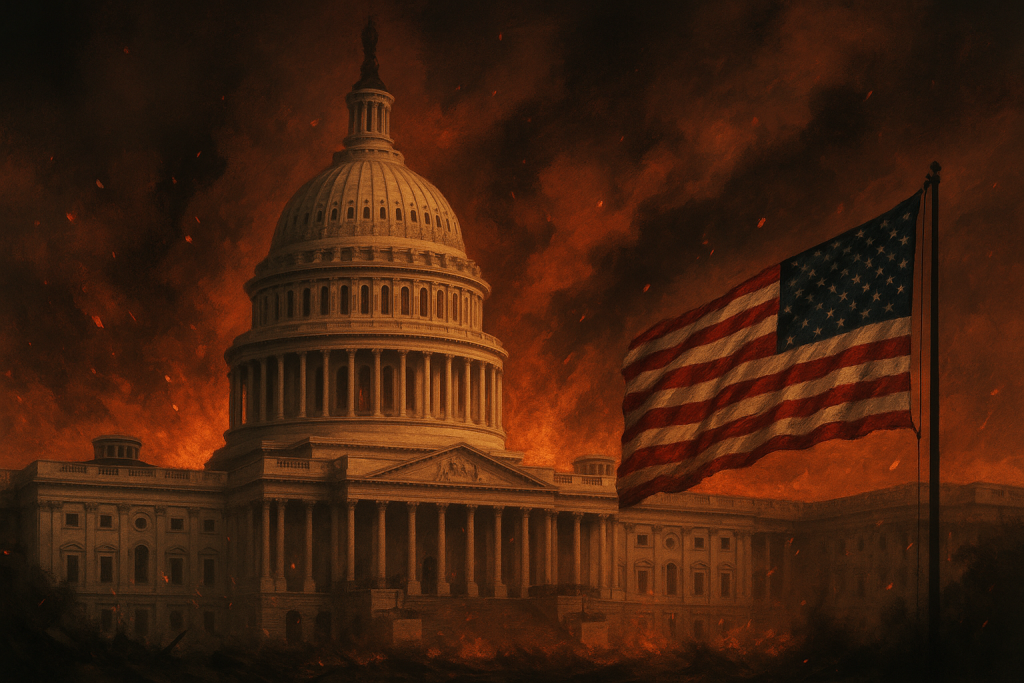
The Collapse of American Democracy
Every generation invents the kind of stories it needs. For ours, those stories often come dressed in flags and shadows — political thrillers about the collapse of American democracy, novels that trade in realism so convincing it feels like tomorrow’s headlines.
Richard Warburg’s Red, White and Blue Land is one such story: part cautionary tale, part mirror. Set in a fractured near-future America, it follows a populist president’s descent into authoritarianism and the fragile attempt to rebuild what’s left. Yet what gives it real weight isn’t its spectacle, but its insight into how nations — and people — slowly trade freedom for certainty.
The Allure of Power, Fear, and Moral Conflict
Political thrillers endure because they dramatize something universal: the tension between ambition and accountability. When institutions start to crumble, the line between hero and tyrant blurs. We’ve seen this in classic works like Robert Harris’s Fatherland and Margaret Atwood’s The Handmaid’s Tale — stories that fuse suspense with social commentary, where fear becomes policy and conscience is tested in real time.
As political theorist Sheldon Wolin once warned, democracies don’t usually die with gunfire; they erode through slow, managerial control. (Wikipedia: Inverted Totalitarianism) Political thrillers exploit that tension. The villains aren’t caricatures; they’re pragmatic, charming, dangerously persuasive.
In Red, White and Blue Land, President Sterling fits that mould. A populist “dealmaker” who believes only he can preserve the union, he mobilizes the military to restore order — and ends up tearing the country apart. His story, though fictional, feels disturbingly plausible. It’s this blend of recognizability and dread that defines the genre: readers see just enough truth to feel the fiction biting back.
The Language of Power and the Weight of Truth
Political thrillers about the collapse of American democracy succeed because they speak a language we all understand — the tension between power and truth. Every command, every decree, every speech in these novels carries moral weight. The dialogue isn’t just political; it’s psychological.
In Red, White and Blue Land, Richard Warburg captures this perfectly. His characters don’t simply debate ideology — they wrestle with conscience. President Sterling’s obsession with unity, Maya Chen’s fragile faith in reform, and Erik Kleist’s calm pragmatism form a triangle of moral gravity that mirrors our own divided age. Through them, Warburg asks a question that extends beyond fiction: when the ideals of a nation begin to fracture, who decides what holds it together?
It’s this moral friction — between conviction and compromise — that defines the best political thrillers. They remind readers that democracy isn’t an institution; it’s a state of mind. Once fear replaces reason, and certainty replaces dialogue, the slide from principle to power happens almost invisibly. The strongest novels in this genre never need to preach. They show how easily good intentions can curdle into control, and how every generation must relearn what freedom actually costs.
A Genre That Grows More Relevant Each Year
Political thrillers have always mirrored the anxieties of their age. During the Cold War, they obsessed over nuclear secrets and espionage. In the digital century, they’ve shifted focus to misinformation, corporate influence, and populist rhetoric.
Thomas Carothers and Brendan Hartnett, in their essay on “democratic backsliding,” observed that the greatest threats to democracy now come not from coups but from elected leaders undermining institutions from within. (Journal of Democracy)
That’s exactly the territory novels like Red, White and Blue Land explore — not an America invaded, but an America imploding.
The fascination lies in moral ambiguity. Readers aren’t looking for pure heroes anymore. They’re drawn to flawed reformers, idealists who compromise, leaders who justify repression for the greater good. These are stories for an audience that no longer believes easy answers exist.
Why Readers Keep Turning the Pages
The best political thrillers are page-turners not because of explosions or chases, but because of ideas in collision. House of Cards, Designated Survivor, and novels like The Ghost by Robert Harris or Our Missing Hearts by Celeste Ng all understand that power itself is the true antagonist.
Warburg’s Red, White and Blue Land adds another layer — it doesn’t stop at collapse; it imagines reconstruction. In the novel’s final chapters, a fragile North American Federation rises from the wreckage, co-led by two reformers who must confront the same temptations as their predecessor. The message is subtle yet chilling: even renewal carries the shadow of control.
This narrative arc reflects what many political theorists now describe as cyclical democracy — a constant struggle between liberty and order. (Foreign Affairs) Each generation inherits both the ideals and the machinery of the last. The machinery is efficient; the ideals are fragile. Thrillers translate that truth into human drama.
The Modern Reader’s Reflection
Readers who turn to political thrillers today aren’t merely seeking escape. They’re seeking comprehension — stories that decode the anxiety behind headlines.
When a president tweets policy, when truth feels negotiable, when partisanship turns into faith, fiction becomes a form of collective therapy.
As CrimeReads notes in its feature on novels about democracy’s end, “These stories endure because they dare to ask whether we’d recognize tyranny if it spoke our language.” (CrimeReads)
Warburg’s novel does exactly that. It’s not polemic; it’s prophecy disguised as plot. By placing readers inside the minds of those on both sides of history, it asks not “What would you do?” but “When would you realize it’s too late?”
Fiction as Warning, and Hope
Ultimately, what gives political thrillers about democracy’s collapse their power is empathy. They remind us that systems fail because people do — and that redemption, if it comes, must also be human.
Red, White and Blue Land closes on a note of uneasy optimism: a new government born from chaos, its leaders aware they could repeat the same mistakes.
That’s the paradox the genre understands better than any other. Democracy’s defenders must wield power to protect it — and in doing so, risk becoming the thing they fear.
These novels endure because they don’t promise triumph. They promise awareness. They hold up a mirror to our ambitions, our complacency, and our longing for order in uncertain times.
They tell us that democracy, like storytelling itself, survives only through constant reinvention.
External References
Journal of Democracy – “Misunderstanding Democratic Backsliding”
Wikipedia – Inverted Totalitarianism
CrimeReads – “5 Novels About the End of Democracy”
ResearchGate – Narrative Definition of the Political Thriller
Foreign Affairs – “Why Democracies Fail and How to Save Them”